Table of Contents
Born in Mallorca, 1958, to a working-class family - both his grandfather and father were blacksmiths - he came to Ibiza aged three. Despite a lifetime on the island, for years he felt rootless. In his family there was no folkloric tradition, no payesa dances, no deeply rooted customs. "I watched my friends dancing and thought: What is this? I feel no connection," he recalls.
At around 27 years old, he felt Ibiza to be a "black hole". The future seemed mapped out: he could become a mechanic, work in his father's workshop and lead a secure life. But life had other plans.
The Door to Art Opens
He met a woman, an artist, who would change everything. "She was my teacher," he says today with deep gratitude. The first painting he saw at her place – exhibited in Ibiza, in Calle Llonga – travelled to New York and was purchased by Yoko Ono's manager.
A time of intensive learning followed. For two years she tried to convince him that he too could paint. He didn't believe her. His hand refused to cooperate – when his head wanted a bottle, his brush did something completely different. "My head and my hand don't work together," he explains.
Then came that decisive night. His teacher, strict and uncompromising, said: "I'll make you an offer. I'll leave you my colours and my brushes. I have an appointment this evening. I want you to paint something."
He painted. "It was a very strange picture, but for me it changed everything. Something happened in here – I laughed, I cried. It was something closed that opened up."
He painted for two years before she told him: "You'll never be a good painter. You have to do sculpture." It took another two years before he found the courage to try that too. And then began an intensive phase: exhibitions at Falcón Blanco, in Sant Llorenç, in Sant Joan. He created a four-metre-high iron sculpture. "They were very intensive years."
The Years of Wandering
But life became complicated. Family conflicts, the death of his parents, arguments with his brother. "It was an intense time," he says quietly. "First you try to keep your balance and lick your wounds like a dog. Then you have to forgive much and be forgiven, to be light, not to carry. Not to carry old stories around with you."
He tried to live elsewhere: New York, Taiwan, Barcelona, finally Cuenca. In total this search lasted around thirteen years. "It cost me so much to accept that my best place in the known world was my home, the place where I live now."
He visited New York about seven times. "Museums, galleries, kilometre after kilometre on foot," he recalls. His teacher had impressed upon him: "You have to see mucho, mucho, mucho from other artists – not to do what they do, not to copy them, but to find yourself."
For ten years he made no art, only working to live.
The Return to Art
Then his wife came into his life, a German woman from Dortmund. One day she said to him: "¡Estás loco! Why don't you go over there, make something, and if it's good, good; and if not, then at least you've got it out of your head."
She was right. He built himself a simple awning as a studio and began working again. His wife found him a gallerist – a German named Ferdin who organised exhibitions at the Milestone (now called Quetzal) between Santa Eulàlia and Sant Carles.
"On a Wednesday or Thursday he came. Friday we hung, Saturday was the opening." And he sold a painting!
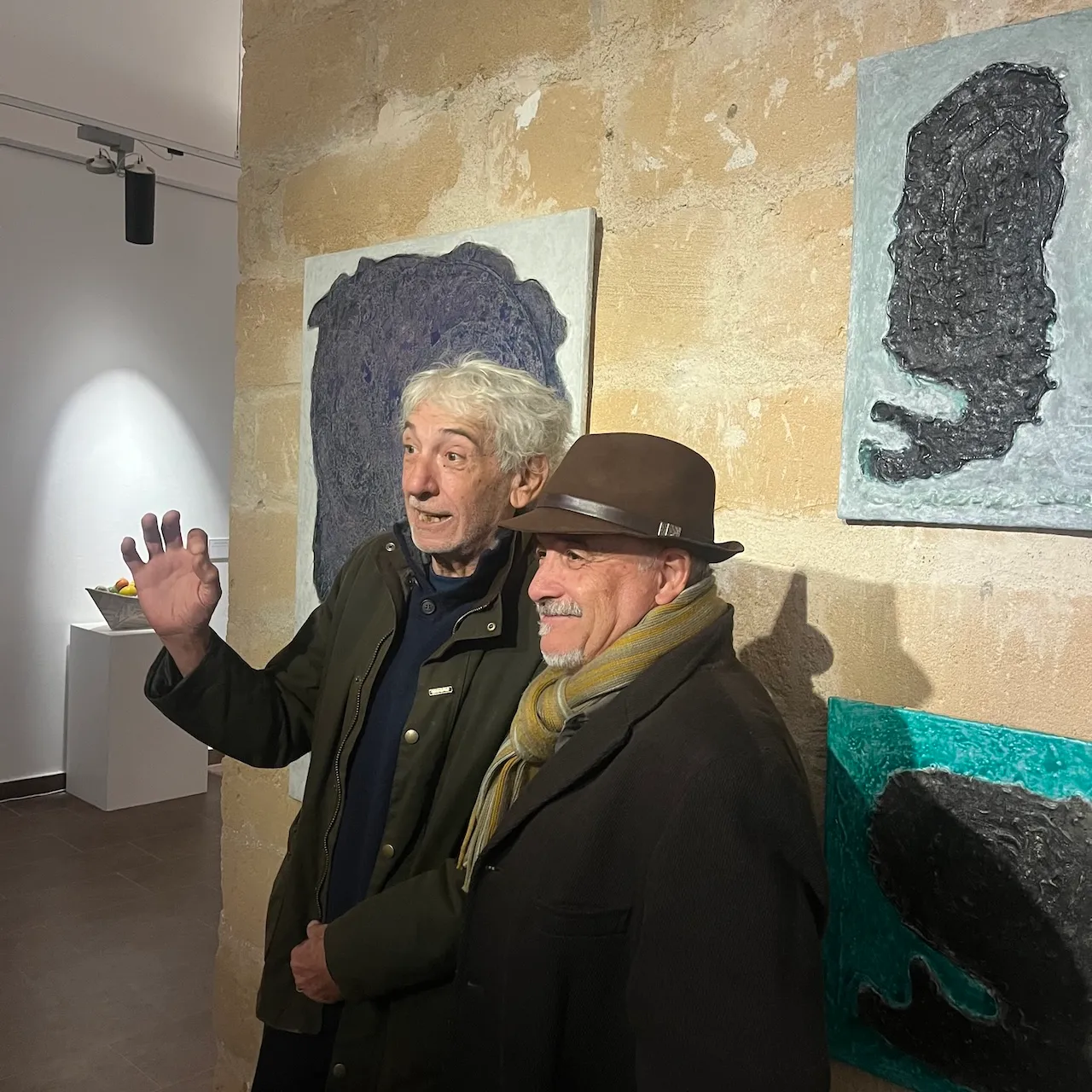
Even more remarkable was a discovery that very evening. A doctor, Alan García, also a sailor, stood for a long time before a blue painting. "He said he didn't understand the painting because he couldn't see a horizon. And he looked and looked, gin and tonic after gin and tonic. Until suddenly he said: 'Now I've got it! You've got a load of boats here.' "
And he was right. The artist himself hadn't consciously painted the boat silhouettes – they had emerged from the gesture. "Later I saw that I had boat silhouettes in several paintings. I'm afraid of the sea – perhaps I have some memory somewhere that gives me this fear. But I have the boat... I don't know."
DNA and Identity
Once he took a DNA test. "My friends always said: 'But you're Phoenician, you must be Phoenician, we're all Phoenicians here.' And it's a lie."
The result: Irish, Italian, Spanish, and 1.2 per cent "base Mediterranean". "Where have the Phoenicians gone?" he asks. "Europe was empty for about 400 years. And then, in the year 1000, something happened in Europe that annulled the old generations. Something very bad happened."
He mentions that the name Marí – very Ibicencan – actually comes from Mesopotamia, from the city of Mari. "The Marís weren't a personal name but a tribal name. Some went to Russia – there's the Mari Republic in Russia. Others went to the Mediterranean."
His brother-in-law was Iranian, a good surgeon in Dortmund, from a family of Ayatollahs. "Iran and Ibiza - I believe they were family." He refers to the Blakstad family, whose father went to Iran and wrote about the architecture – the payesa houses of Ibiza were exactly the same as houses in Lebanon and Iran.
"Western society has somehow mutilated the information," he says. "We Europeans are... We're bloody parasites. We've gone and stolen everything. The English went to India, stole everything. To China. Parasites. History is... halved."
Where Silence Dwells
Today he calls his studio "south of reason, where silence dwells". "When you have silence in your head, what you need to absorb, what needs to flow, can function. But if you're full of past, stories, nonsense, rubbish, whatever, you can't function."
He meditated for years, occupied himself with Buddhism. "I suffered a great deal in some places. But in the end I understood one thing: The most important thing is silence in the head."
His working method is simple: mornings the normal life, afternoons to the studio. "Even if you don't do anything, just listen to a bit of classical music and have something started there. And then: What do you want? Nothing. Do you understand?"
He often doesn't title his works. "If I give a title and someone comes and sees something else, I'm conditioning something. I don't care whether I call it red or white. But the person might say: 'Ah! That's coral, and you made it for me.' Okay, that pleases me. So as not to condition anyone's vision."
Art and Market
He speaks of the art market with scepticism. "If I sell a painting for 500 euros and then someone says: 'This painting is worth 5,000', they destroy your life. I've seen exhibitions in Ibiza – paintings for 50,000, 40,000. Will you put 40,000 in the artist's pocket? No. It's business."
He believes in coherence between trajectory, price, and public reception. "If you're nobody and your work costs 100 euros and in five years 500 – perhaps there's a coherence there. But the moment someone comes along and something breaks with the price, it's no longer art. You're in a magic of money."
On conceptual art he says: "If you have a small work and such a thick book to explain the concept – that's not art. If someone doesn't understand this work and needs such a large explanation, that's intellectual decadence."
His wife once illustrated this for him. "If you buy a painting, do you then have to invite the artist every year to explain the concept to you again because you don't remember?"
Experimenting and Living
His practice is experimental. Someone gave him oil paints from Dutch grandparents – "but I don't know how to use them. Sometimes I confuse things, oil and water don't go together." He laughs. "Mine is to experiment. If something good comes out, good, and if not, you start again. Like life."
Art doesn't give him his livelihood – for that he has a rental property. "Painting is my life. Without it I'd be very bored. Honestly."
For eight years he was in the artists' association AMAE/ABIB, did group exhibitions at the lighthouse, at the windmills in Sant Antoni, at the congress palace, in the street. "It was good, but they were group exhibitions, one after another. And one day I said: That's enough, I don't like it any more. I grew tired of going down to Ibiza so many evenings."
Last year he had his first major solo exhibition in Sant Joan – about 38 pieces. "Well sold, people liked it, it was very good." Vicente Torres came and subsequently invited him to exhibit in Sant Antoni.
The Generation Between Two Worlds
"I think we're a generation between two worlds," he reflects. "I was born too late. I had all the hippie influence, the smoking, the parties, everything. But I was too young. I was born in 1958. The music, the hippies, that was all in the 60s, 70s. And I was very young. So I stand between one generation and the other."
He needed twelve years and a journey around the world to recognise what he knows today: his best place is where he is now. Not because of folklore or tradition, but because of experience. "If belonging exists, it is constructed."
In his studio, south of reason, where silence dwells, he has found his peace. Not loud, not grandiose. Only routine, work, trials. And when something doesn't work, start again.
"There's a part of us that has no age and never will," he says in parting. "Before and after. We continue. Even when we die, we continue somewhere. With the family that has gone, and with everything."
An artist between two worlds who has found his place – not through slogans, but through silence.
"As so often in the great stories, the treasure lay all along where the journey began. But without the search, he would never have seen it." AR*
Based on an interview with an Ibizan artist (born 1958), recorded in Es Canar, November 2025.